
How to Size a Solar Battery Bank for Reliable Backup Power
2026-11-01T03:07:00+00:00
To size a solar battery bank, calculate the energy your selected loads need during the backup period, then allow for the permitted discharge window, conversion losses, temperature and aging. Check power output separately. Finally, confirm that the solar array or another charging source can restore the energy before the next discharge.
A battery quotation can look convincing and still leave a project short of runtime. The missing detail is often the meaning of “capacity.” A nameplate describes stored energy under stated conditions; your equipment receives a smaller amount after operating limits and losses. This guide explains how to size a solar battery bank for that delivered energy, using a small commercial application and published technical references. It is written from the supplier side: the worked example is built on one of our own 5.12 kWh modules, so every input can be checked against a published datasheet, and that result is then set against the other storage formats a buyer is likely to be offered.
Contents
Define the load and backup period
Calculate the capacity that can reach the load
A worked example using modular storage
Check voltage and discharge power before ordering
Verify that the system can recharge
What a documented hospital microgrid shows
Frequently asked questions
Define the load and backup period
Start at the circuits the battery must support. An electricity bill gives total consumption, but it does not identify the energy needed by a refrigeration circuit, communications equipment or essential office loads during an outage. Use interval meter data or measured equipment consumption wherever possible.
For a reasonably steady load, energy in kilowatt-hours equals power in kilowatts multiplied by operating hours. For cycling equipment, use measured energy or realistic equivalent operating hours. A compressor nameplate multiplied by 24 hours can substantially misrepresent its consumption.
Battery bank sizing for backup power also depends on when an interruption begins. Eight hours overnight may require a different amount of stored energy from eight hours during working hours. Define the protected circuits and the outage window before choosing a module size.
For a business, discuss which activities continue during that window. Keeping a production line running requires a different load profile from stopping production safely while maintaining refrigeration and controls. If operators can defer a process, record that assumption in the operating plan. Otherwise, the battery calculation may depend on load shedding that nobody actually performs.
For off grid solar battery bank sizing, “days of autonomy” means the period the bank should support the defined load without effective replenishment. Choose it from the site's weather, acceptable interruption risk and available generator support. Two days is a design decision, not a universal standard. Where solar is credited during an outage, model its timing against consumption.
Calculate the capacity that can reach the load
Separate rated energy from the operating window
Nominal energy is approximately nominal voltage multiplied by ampere-hour capacity, divided by 1,000. The System Advisor Model documentation distinguishes nominal bank capacity from usable capacity and separately defines bank power. Those distinctions matter when reading a supplier's specifications. [1]
Depth of discharge, or DoD, describes the fraction of capacity withdrawn. State of charge, or SOC, describes what remains. Operating between 100% and 20% SOC gives an 80 percentage-point window. Starting at 80% and stopping at 20% gives only 60 percentage points, even if the battery permits deeper discharge.
This matters for a system that uses storage every evening while also promising emergency backup. Energy already spent on self-consumption is unavailable when the grid fails. Set the backup reserve explicitly in the controller.
Use a consistent calculation boundary
For a preliminary solar battery capacity calculation with AC loads, use:
Nominal battery energy = (AC load energy ÷ discharge-path efficiency + DC auxiliary energy) ÷ (usable SOC fraction × retained-capacity fraction × temperature capacity factor)
AC load energy covers the whole backup interval. Discharge-path efficiency covers the one-way losses between stored DC energy and the AC load. DC auxiliary energy covers battery-side consumption not already counted, such as inverter standby demand. Express every energy term in kWh.
Use the permitted SOC window for the usable fraction. Retained capacity represents the capacity available at the chosen design age; the temperature factor represents the applicable reduction under site conditions. Obtain these inputs from the selected equipment's documentation and project requirements.
Do not insert round-trip efficiency automatically into this discharge calculation. Round-trip efficiency includes charging losses as well. Those losses belong in the replenishment assessment. Likewise, if a supplier quotes usable AC energy with losses and reserves already included, applying the same deductions again understates capacity.
A worked example using modular storage
Consider an illustrative small workshop with a refrigeration circuit and essential office equipment. The following load profile is an assumption for explaining the calculation, not measured customer data, and not a specific installation of ours.
Protected load | Operating power | Equivalent hours per day | Daily energy |
Lighting | 0.12 kW | 12 h | 1.44 kWh |
Communications and controls | 0.10 kW | 24 h | 2.40 kWh |
Refrigeration compressor | 0.80 kW | 4 h | 3.20 kWh |
Office and workshop equipment | 0.37 kW | 8 h | 2.96 kWh |
Total | — | — | 10.00 kWh |
Assume one day without replenishment, a full battery at outage start, an 80% operating window and 92% discharge-path efficiency. Assume installation conditions require no temperature capacity reduction. For clarity, auxiliary demand is omitted here; a project calculation must include it separately or within a properly defined efficiency model.
At beginning of life, the required nominal energy is 10 ÷ (0.80 × 0.92) = 13.59 kWh. If the same runtime must be maintained at 80% retained capacity, the requirement becomes 10 ÷ (0.80 × 0.92 × 0.80) = 16.98 kWh.
The two 80% inputs serve different purposes. One limits the operating window; the other allows for capacity loss with age. The latter is an illustrative design target, not a warranty figure for any particular module; check it against the cycle-life and capacity-retention data published for the model you are actually buying. SAM models both calendar and cycling degradation, so a cycle count alone cannot establish available capacity throughout service. [2]
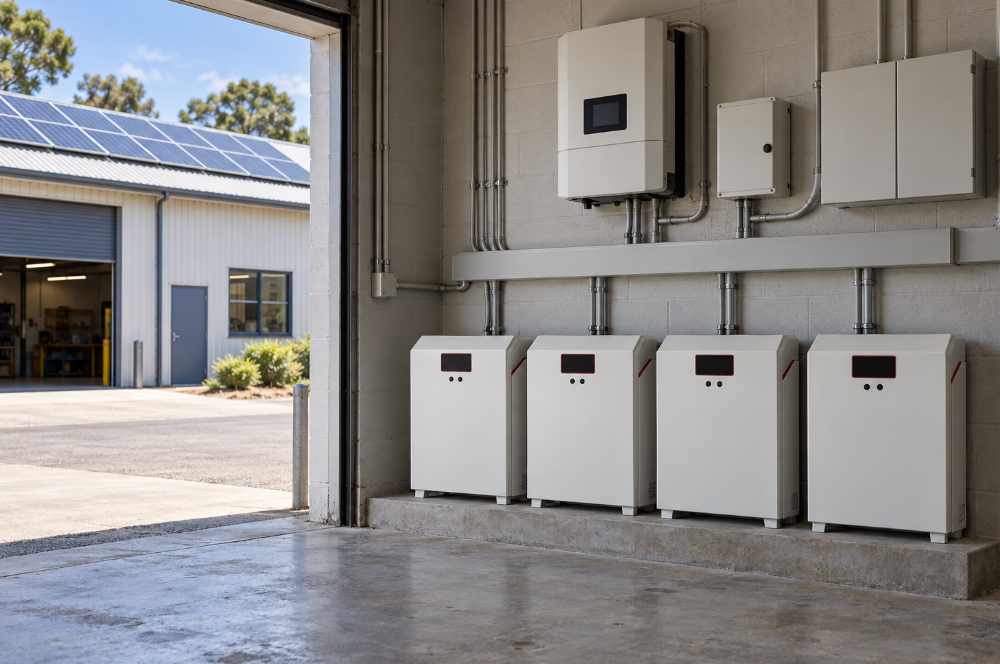
Take a low-voltage module from our own range, the DW-KNY-E-5: 51.2 V nominal, 100 Ah, 5.12 kWh rated, and the arithmetic closes at 51.2 × 100 ÷ 1,000 = 5.12. [3] Our datasheet is used here for a practical reason — you can check every input — and the method is unchanged whoever's module you put in its place.
Rounding the aged-capacity requirement up to whole modules gives four modules: 16.98 ÷ 5.12 = 3.32, rounded up. The resulting bank has 20.48 kWh nominal energy. Under the stated assumptions, it can deliver approximately 12.06 kWh AC at 80% retained capacity. Three modules would deliver about 9.04 kWh and miss the target.
That is the practical value of learning how to size a solar battery bank: a nominal 15.36 kWh bank can meet a 10 kWh requirement when new yet fall short at the chosen design age. The four-module result remains preliminary until auxiliary demand, compatibility and site conditions are resolved.
How this compares with the other formats you will be quoted
The four-module answer belongs to one format. The same 10 kWh requirement lands differently depending on what is being offered:
l Low-voltage modular, 5 kWh class (48 V / 51.2 V). Smallest unit, easy to parallel up to a target, and one failed module costs a fraction of the bank rather than all of it. The trade-offs are more cabling and connections, explicit parallel-count limits, and more wall or floor space per kWh.
l All-in-one cabinet, 10 kWh class. Fewer connections, one BMS, faster to install. Expansion is coarser, and a single fault takes the whole bank offline.
l High-voltage stacked, 2.5-5 kWh per stack (100-400 V). Lower current for the same power means thinner cable and less resistive loss on larger loads. It needs an inverter designed for that voltage range, and costs more per kWh at small sizes.
l Lead-acid, for example a 48 V 200 Ah bank at about 9.6 kWh nominal. Low purchase price per kWh and a well-understood technology. In practice the usable window is nearer 50%, cycle life is several hundred to roughly a thousand cycles, and the temperature and ventilation requirements usually erode the price advantage over the life of the system.
None of these is universally better, and the deciding questions stay the same as above: how much energy has to reach the load, how often, how much space and cabling the site can take, and whether the bank must grow later. Modular low voltage suits a site that starts small and expands; a single cabinet suits a site where installation labour dominates; high voltage pays off as power rises; lead-acid tends to win on first cost alone.
Check voltage and discharge power before ordering
Translate capacity into a compatible bank
For 48V solar battery bank sizing, use the battery's actual nominal voltage in the energy conversion. A system described as “48 V” may use 51.2 V nominal LiFePO4 modules. Four compatible 51.2 V, 100 Ah modules connected in parallel provide 51.2 V and 400 Ah, rather than a higher nominal voltage.
Only use connection arrangements approved for the exact battery model. Voltage range, communications protocol and inverter firmware must all match. A CAN or RS485 connector by itself does not establish compatibility. [3]
Confirm the weakest power limit
LiFePO4 battery bank sizing must satisfy discharge current as well as energy. In a separate power illustration, a 5 kW AC load at 92% conversion efficiency draws approximately 106 A at 51.2 V. At 44 V it draws about 124 A. These are calculated operating points, not approved equipment ratings.
For that module the published figures are 50 A recommended and 100 A maximum discharge. [3] Confirm the permitted duration of maximum current and the complete parallel-bank limits. Do not assume a maximum rating is an unrestricted continuous operating point.
For a compressor or pump, check starting demand against the inverter's overload curve and battery management system limits. Also confirm island-mode output and phase requirements. A bank can have enough energy for the day and still trip during a motor start. Cable, protection and connection design must support the same operating envelope.
Before acceptance, agree on a runtime test with a defined starting SOC, connected load and stopping threshold. Record AC energy delivered, battery current and temperature rather than relying only on a dashboard percentage. Test transfer to backup operation as well. A successful energy calculation does not establish how quickly the system transfers, whether sensitive equipment rides through, or whether the selected inverter can restart the intended loads after a shutdown.
Verify that the system can recharge
A larger bank extends runtime, but it also increases the energy that must be restored after a deep discharge. The array must cover concurrent daytime loads and charging losses before its remaining output can replenish storage.
For illustration, suppose a discharge removes 12 kWh of stored energy and measured operating conditions provide a net restoration rate of 3 kW after daytime consumption and charging losses. Restoring that energy takes at least four hours. Charge tapering, temperature restrictions and changing sunlight can extend the period.
Use location-specific generation estimates. PVWatts V8 provides monthly and hourly PV production outputs; these can inform a solar-plus-storage model, but PVWatts alone does not establish battery autonomy. An annual energy total can conceal a winter shortfall. [4] For a demanding off-grid project, assess the sequence of poor-weather days and the recovery period with time-series storage modeling.
Temperature requires a separate check. Our own specification is charging at 0–55°C and discharging at −20–60°C. [3] A permitted discharge temperature does not prove full rated capacity is available there. Obtain the model's capacity-versus-temperature data and account for any heater or cooling consumption. Other battery designs can have different limits. [5]
What a documented hospital microgrid shows
The US Department of Energy's published Richmond Medical Center case describes a Kaiser Permanente microgrid with 250 kW of solar and 1 MWh of battery storage. Its stated backup objective was a minimum three-hour window for the life safety branch, including emergency lights and alarms. [6]
This is a documented third-party example, not one of our own projects. Its useful lesson is the defined load boundary: the published storage figure supports a specified part of the facility. It does not imply three hours of operation for the entire hospital. Apply the same discipline when a factory asks for “whole-site backup.”
Frequently asked questions
How many batteries do I need for my solar system
Divide the required nominal bank energy by one compatible module's nominal energy, then round up. Check the resulting bank against power, current, inverter and parallel-connection limits. The worked example needs four 5.12 kWh modules under its stated assumptions; another load profile may produce a different result.
Is a solar battery bank sizing calculator enough
A solar battery bank sizing calculator is useful for an initial estimate if its inputs and loss boundaries are visible. It cannot establish motor-start performance, inverter compatibility or weather resilience from daily kWh alone. Retain the assumptions so an engineer can review the result.
Can a 10 kWh battery supply a 10 kWh daily load
Check whether the rating means nominal DC energy, usable DC energy or usable AC energy. A 10 kWh nominal bank with an 80% window and 92% discharge efficiency delivers approximately 7.36 kWh AC when new, before separately counted auxiliary consumption or temperature reductions.
Should future expansion be included now
Include a defined future load if it is part of the project. Confirm expansion limits and whether later modules may be mixed with older units. Do not assume that an empty cabinet position guarantees electrical compatibility or that planned expansion will be available during an outage today.
Conclusion
Knowing how to size a solar battery bank means connecting the protected load to an achievable runtime. Calculate delivered energy, choose an explicit SOC window, allow for aging and temperature, then verify power and replenishment. If you would like a proposal from us, share the load profile, required outage window, inverter details and installation conditions so the configuration can be checked against those requirements.